Award-winning Music Producer Alicia Kreckel talks capturing details with Genelec
What’s your name, and where are you based?
I’m Alicia Kreckel, also known as Alycce, and I’m based in Berlin, Germany.
When did you start producing, and what drew you into it?
I studied Music Technology with a focus on recording, mixing, live sound and acoustics. During my studies, I also spent a lot of time working in audio post-production for TV, which gave me a strong technical foundation and trained my ears from an early stage.
Towards the end of my studies, I started spending more time in the studio with artists, and I eventually moved into production. Once I started building productions from scratch, I was hooked. There’s something incredibly rewarding about creating something that didn’t exist before and watching an idea grow into a finished record – it’s one of the best feelings in the world. I think I’ve always been drawn to music because it lets me translate emotion into something tangible, something you can physically feel when it works.
You won 'Best Engineered Song' at the German Songwriting Awards.What did that moment mean to you?
It was a very special moment, because engineering is often one of the less visible parts of music creation. Receiving recognition for that side of my work felt incredibly validating. It reminded me that all the attention to detail and countless hours spent refining sounds really matter.
Can you tell us a bit about the track that won the award?
The song “Tu Dir Nicht Gut” by Aleyna was created with the goal of combining emotional impact with a polished, modern sound. We wanted every element to support the story of the song while still feeling exciting and contemporary. We wrote the demo relatively quickly and then spent a lot of time adding all the little details that helped bring the song to life. A lot of care went into creating depth, movement and clarity throughout the production.
What do you think made the production/engineering stand out?
I think it was the balance between emotion and precision. We paid a lot of attention to the details, but always with the goal of supporting the song rather than showing off the production. Every sound, vocal layer and effect had a purpose. The technical side was there to make the emotion hit harder.
How do you approach production from an engineering perspective?
For me, engineering starts while writing the song. I'm already shaping the mix during the production process and thinking about sonics when choosing sounds, recording vocals or building an arrangement. If the foundation is strong, the mix becomes much easier later on.
I always try to balance creativity with technical precision and make decisions that serve the emotion of the song. At the end of the day, great engineering isn't about showing off technical skills, it's about helping the listener connect with the music.
For me, production is about translating emotion into sound in a way that people can actually feel, not just hear.
What are the small details you obsess over when working on a track?
I love working on vocal arrangements and adding those little melodies or textures that people sometimes only notice after listening to a song several times. They might not be obvious at first, but they can completely change how a track feels. Those details are often my favourite part of the process.
Do you have any habits or processes that define your sound?
I always try to understand the emotion of the song first. I love figuring out the topline and lyrics before diving deep into production because it helps me build a sonic world around the feeling of the record. Once I know what the song wants to say, the production decisions become much clearer.
Can you describe your studio setup in Berlin?
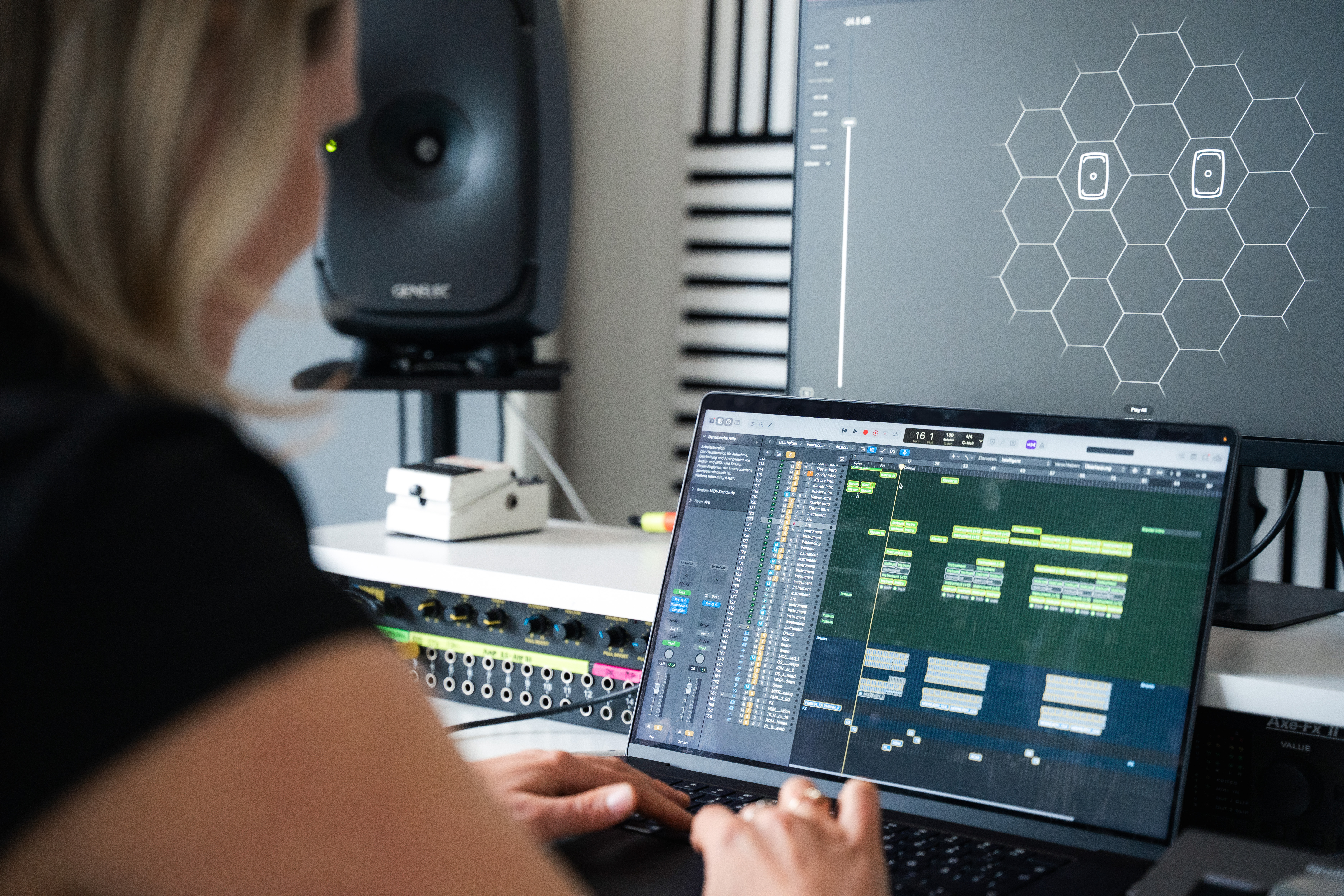
I work out of Bluhaus Studio in Berlin. My setup includes Genelec monitors, an Apollo interface, several analogue synthesisers, guitars and pianos. I like having instruments ready to go because it keeps the creative flow moving. For me, the most important thing is having a setup that allows you to plug in, experiment and capture ideas quickly.
What role do monitoring and accuracy play in your workflow?
Monitoring plays a huge role in my workflow because every decision I make is based on what I hear. Whether I’m writing, producing or mixing, I want to trust that what I’m hearing is accurate. The more confidence I have in my monitoring, the more I can focus on being creative instead of second-guessing technical decisions.
At what stage of production is sound precision most important to you?
I think it's important throughout the entire process, even during songwriting. Of course, there's always room for adjustments later on, but if you can already capture the right sound and emotion in the demo, it makes everything much easier.
People naturally get attached to the sounds they hear in the early stages of a song, so having a strong sonic vision from the beginning is incredibly valuable. The better the foundation, the stronger the final record will be.
You’re using the 8341s. How do they fit into your setup?
The 8341s are at the centre of my setup. They’re my main point of reference for production and mixing decisions. They allow me to hear details clearly while still feeling connected to the music emotionally, which is really important for the type of records I make.
What difference do they make in your daily work?
They help me work faster and with more confidence. I spend less time checking mixes on different systems, because I trust what I’m hearing. That allows me to stay focused on making creative decisions instead of constantly questioning technical ones.
How do they help you make better mix or production decisions?
I can trust them. I’ve worked with Genelec monitors for the past six years, so I know exactly what they sound like. Even after moving studios several times, the GLM system allows me to keep a familiar reference point. That consistency helps me make decisions quickly and confidently.
Can you recall a moment where your monitoring made a real difference?
There have been many moments where I thought a mix was finished, but my monitoring revealed small balance issues that would have translated poorly on other systems. Especially when working on vocals and low-end, being able to hear those details early often saves a lot of time later in the process.
What’s next for you after this award?
I’m focused on expanding my work internationally, collaborating with new artists and writers, and continuing to develop records that combine strong songwriting with world-class production. I’m particularly excited about building new creative relationships in the UK and beyond.
Are there any projects or collaborations you're excited about?
I’m excited about a lot of the music I’m currently working on. I’ve been fortunate to collaborate with some amazing artists and writers recently, and I’m looking forward to seeing where those songs go. More than anything, I’m excited to keep growing, learning and creating music that connects with people.
